

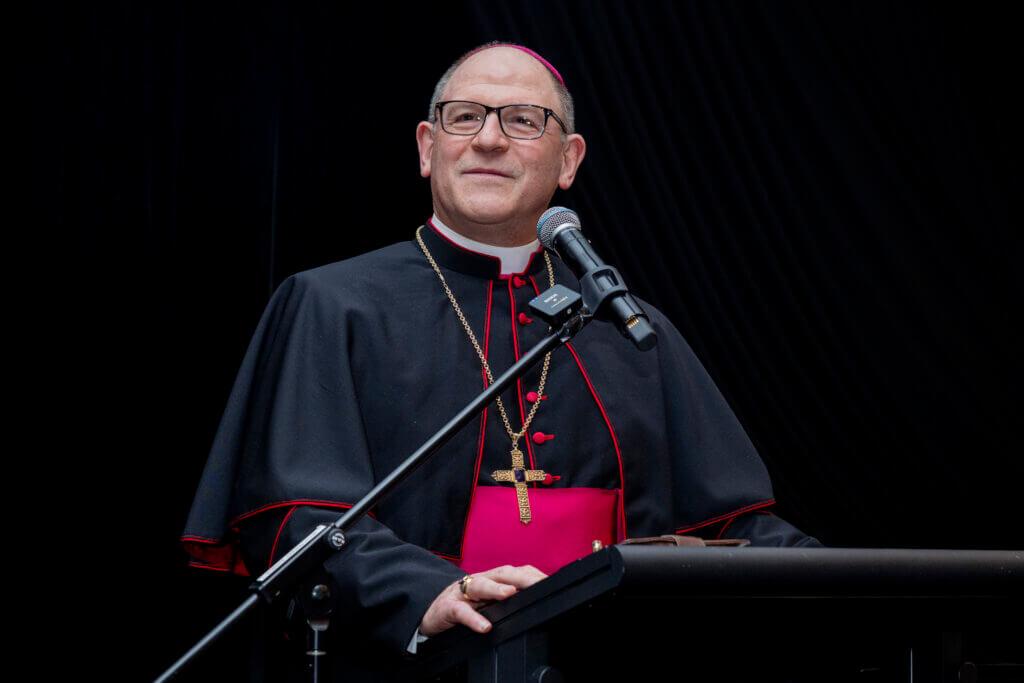
Pictured: Monsignor Anthony Randazzo, Prefect of the Dicastery for Legislative Texts
Soon we are going to celebrate the sixth anniversary of the creation of the online periodical Journal Vox Canonica, dating back to October 2020. Since then, like a sentry, Vox Canonica has endeavoured to spread the knowledge of Canon Law as part of the Church’s mission through articles, in-depth studies, interviews, etc. In view of the coming anniversary, we deemed it appropriate to interview His Most Reverend Excellency Monsignor Anthony Randazzo, the newly appointed Prefect of the Dicastery for Legislative Texts. This is the first interview that Monsignor Randazzo has granted, addressing important issues such as the pastoral mission of Canon Law within the mission of the Church and how he intends to face the challenges ahead of him in his service of the Church’s good, whilst following in the footsteps of those who preceded him in this important Dicastery of the Roman Curia.
The words he shared with us reveal the profile of a Bishop and a minister of justice endowed with great legal abilities and a particular ecclesial sensitivity, capable of synergising the law, the pastoral ministry, the Gospel, and the principles of justice and truth, for the sake of the salus animarum. We thank His Excellency Monsignor Anthony Randazzo for his availability and for the passionate, meaningful, and profound words he entrusted to us with respect to the importance of Canon Law in the pastoral action of the ecclesial community and as an instrument at the service of the Church’s communion, its mission, and the proclamation of the Gospel.
On the 25th of March, you were appointed Prefect of the Dicastery for Legislative Texts. This important and delicate service to the Universal Church takes place against a complex and unique historical backdrop, in a ‘time of great change’. How do you intend to tackle the challenges pertaining to your office at a time when there is much talk about reforms, synodality, and processes of accompaniment?
Firstly, I would begin by reiterating that every generation faces its own challenges. We are not so different from those who have gone before us, nor from those who will come after us. There is a tendency to regard our own age as uniquely complex, so that the issues we face seem to confuse and confound us. Yet Jesus Christ is “the way, and the truth, and the life” (Jn 14:6). He must be our beginning and our end; he alone is our enduring reference point.
Secondly, I do not believe I can engage with Canon Law unless I have first been nourished by the Gospel, because the law is always at the service of the Gospel. Our vocation as canonists is not simply to interpret legislation. Our task is to ensure that the juridical life of the Church always serves her evangelical mission. The Gospel must remain the lens through which we understand, interpret, and apply the law entrusted to us.
Thirdly, in light of these first two principles, I believe there is greater substance in speaking of regeneration rather than merely reform. To regenerate is to return to the genesis of our identity and mandate as disciples of Jesus Christ. Canon law itself is structured upon the ecclesial foundations that arise from Sacred Scripture and Sacred Tradition. The Council Fathers of the Second Vatican Council reminded us of this enduring reality in Dei Verbum:
«Hence there exists a close connection and communication between sacred tradition and Sacred Scripture. For both of them, flowing from the same divine wellspring, in a certain way merge into a unity and tend toward the same end. … Consequently, it is not from Sacred Scripture alone that the Church draws her certainty about everything which has been revealed. Therefore, both sacred tradition and Sacred Scripture are to be accepted and venerated with the same sense of loyalty and reverence.» (Dei Verbum, 9)
The law, therefore, does not stand apart from Revelation but serves it. Its purpose is to safeguard and foster the communion of faith received from the Apostles.
Fourthly, synodality and accompaniment are not new realities. They are contemporary expressions that seek to help the Church «scrutinise the signs of the times and interpret them in the light of the Gospel» (Gaudium et Spes, 4). Although the vocabulary is new, the underlying ecclesial reality is already embodied in the Church’s life and canonical tradition.
Indeed, both the Latin Code of Canon Law and the Code of Canons of the Eastern Churches contain numerous examples of ecclesial life, mission, and ministry that are authentically synodal and that necessarily require accompaniment.
Together, the following six canons reveal three recurring juridical patterns that are foundational to a synodal Church:
- Communion: all the baptised share equal dignity and responsibility (CIC c. 208; CCEO c. 7).
- Participation: the faithful are called to contribute to ecclesial discernment through dialogue and consultation (CIC c. 212 §3; CCEO c. 15 §3).
- Mission through accompaniment: pastoral ministry is exercised by walking with persons over time, particularly in vocational and family life (CIC c. 1063; CCEO c. 783).
These canons demonstrate that accompaniment is not simply a pastoral method but a juridical expression of the Church’s communion, participation, and mission, the three constitutive dimensions of synodality identified by the Synod on Synodality (2021–2024).
Finally, as Prefect of the Dicastery for Legislative Texts, it is my intention to remain calm, to listen attentively to the needs of the Church as she dialogues with the world, and to encourage all the faithful to remain steadfast in Christ, faithful to the profession of our faith, and united in the One, Holy, Catholic, and Apostolic Church.
Canon Law has never existed for its own sake. Its purpose is to serve the mystery of the Church and the mission entrusted to her by Christ. For this reason, I hope that every decision, every interpretation, and every initiative taken by the Dicastery in support of the Holy Father’s legislative authority will be guided by the principle with which the Code of Canon Law itself concludes: «…the salvation of souls, which must always be the supreme law in the Church, is to be kept before one’s eyes» (salus animarum suprema lex; CIC c. 1752).
When the world presents new challenges, our response remains the same: to proclaim Christ faithfully, to serve his Church wisely, and to ensure that the law remains an instrument of communion, justice and, above all, the salvation of souls. That is our modus operandi. That is our mission.
Was studying Canon Law your own choice or was it ‘imposed’ on you by your formators? Can you tell us how your love of Canon Law began?
During my years of seminary formation for priestly life and ministry, the study of Canon Law formed an integral part of our academic curriculum. I embraced it from the beginning and genuinely enjoyed it. I should say, however, that my appreciation of Canon Law was preceded by a love of ecclesiology and ecclesiastical history. Those disciplines provided the foundation upon which a sound understanding of Canon Law could be built.
I was also blessed with outstanding professors of ecclesiology and Canon Law. They were marvellous priests — good and virtuous men whose lives reflected what they taught. They demonstrated a deep love for the faith, for the Church, and for her rich history and culture. For me, it was a fertile seedbed. They faithfully taught the doctrine of the Church, the discipline of Canon Law, and above all the virtues of truth, fidelity, and service that are to characterise every disciple of Jesus Christ.
After six years of priestly ministry, my Archbishop invited me to undertake my studies in Canon Law in Rome. At first, I was quite surprised. My own desire was to continue serving as a parish priest. However, I recognised that the needs of the local Church were greater than my personal preferences. That was the reason why I accepted his invitation. I was available because my Archbishop believed the Church needed this service from me. In that sense, my decision was an expression of priestly obedience to my Ordinary.
When I arrived at the Pontifical Gregorian University, I found myself in a classroom with 108 fellow students from every corner of the world — men and women, lay faithful, religious, and ordained ministers. It was a wonderful expression of the universality of the Church. Our professors were inspiring scholars who combined academic excellence with a genuine love for the Church. The programme was demanding, but immensely rewarding. Many of the friendships formed during those years remain among my closest to this day.
It was in that international and ecclesial environment that my appreciation for Canon Law matured into a genuine love for it. More importantly, however, I came to love even more deeply the Church that Canon Law exists to serve. I discovered that Canon Law is not simply about rules or procedures; it is about fostering communion, safeguarding justice, and enabling the Church to fulfil her mission of proclaiming the Gospel.
Until a few months ago, you were at the helm of the Australian Diocese of Broken Bay; Pope Leo saw in you someone who combines a solid grounding in Canon Law with the practical approach of a pastor, thereby entrusting you with the leadership of a Dicastery that does not make as many headlines as others, but which quietly shapes the day-to-day life of the Church. How do you intend to ensure the correct application of Canon Law whilst meeting the pastoral needs?
The Diocese of Broken Bay has been the great love of my episcopal ministry. She was the Bride entrusted to my pastoral care, the local Church whom I was ordained and anointed to serve, to lead, and to love. In this sacred ministry, one can never be merely an administrator. One must first and foremost be a husband, a father, a priest, a teacher, and a shepherd of souls.
Being the Bishop of a Diocese is not about status, titles, or prestige. It is the privilege of walking with the People of God as fellow pilgrims in faith, hope, and charity. It is precisely this experience of pastoral life and episcopal ministry that I bring with me to the Dicastery for Legislative Texts.
Most of what I have done during thirty-five years of priestly ministry has gone unnoticed, and rightly so. Ultimately, it is God’s work, not mine. I simply pray that I never become an obstacle to God’s grace, but rather a faithful instrument through which he may continue his work in the life of the Church.
If I may, I would also gently challenge the premise of your question, because it seems to place the correct application of Canon Law and pastoral care in opposition to one another, as though one must choose between them. I do not accept that distinction.
The correct application of Canon Law is itself a profoundly pastoral act. Indeed, it cannot be otherwise. If the law is applied in a manner that is not pastoral, then it risks becoming unfaithful both to the mission of the Church and to the mind of the legislator. Canon law exists not as an end in itself, but as a servant of the Church’s communion, her mission, and the proclamation of the Gospel.
Fidelity to the Bride of Christ, love for her life and mission, reverence for the truth of the Gospel, concern for justice, and care for the dignity of every person: these lie at the very heart of the Church’s canonical tradition. When law is understood in this way, it does not stand in tension with pastoral ministry; it becomes one of the privileged instruments through which the Good Shepherd continues to care for his flock.
As Pope Francis reminded canonists, the virtue proper to our discipline is prudentia iuris, juridical prudence.[1] It is the wisdom to apply the law faithfully, justly, and pastorally, always remembering salus animarum suprema lex.
The role of the Dicastery for Legislative Texts is crucial in ensuring consistency, transparency, and rigour in the governance of the Church. The office entrusted to you drafts and interprets canonical norms and provides expert advice to Dioceses and other bodies of the Holy See. How can we help the Church preserve the inseparable link between truth, justice, and charity?
Addressing the relationship between justice and charity, Pope Benedict XVI taught in Caritas in Veritate that charity «goes beyond justice» but «never lacks justice». They are not the same; yet they are intimately bound together. Justice gives each person what is due, while charity perfects justice through the logic of self-giving love.
I am inspired by this teaching because it brings me closer to understanding that justice and charity, when seen through the eyes of faith, reveal the truth: the truth regarding the human person and the divine Truth, which is the source of all authentic charity and justice. This may sound like an overly theological reflection; however, if we fail to ponder this deeper meaning, we risk reducing the Church’s mission merely to advocating for social reform, ecclesial renovation, or administrative restructuring.
The work of the Dicastery for Legislative Texts must allow for an honest, consistent, and transparent governance in the Church. Governance is never merely administration. It is a service to the communion of the Church and to her mission in the world.
We are living in a moment of great importance in the post-Vatican II Church, where a faithful reading of the conciliar documents is essential for understanding the mission of the Church and, consequently, the true nature and purpose of her Canon Law. The documents of the Council must be read in their entirety and according to their theological vision, rather than selectively or simply by identifying isolated passages that support a particular interpretation.
Pope John Paul II expressed this profound relationship between the Council and the law of the Church in the Apostolic Constitution Sacrae Disciplinae Leges, explaining that the Code of Canon Law should be understood as an instrument that expresses the spirit of the Council and makes its ecclesiology visible in the Church’s laws.
This is how we enable the law to be rigorous in its application: not through technical precision alone, but through a deeper knowledge of Sacred Scripture, the Tradition of the Church, the concrete realities of human life, and the mystery of faith. Canonical rigor must always be united with justice and charity, because the law of the Church exists not only to regulate, but to serve the truth of communion.
As Pope Leo XIV reminded the Vatican judiciary, authentic justice is not merely the application of rules, but «an ordered form of charity.» [2] Quoting Saint Augustine, he recalled that «perfect charity is perfect justice» (caritas perfecta, perfecta iustitia est). This is the path by which the Church preserves the inseparable bond between truth, justice, and charity.
What contribution can the Code offer in this ecclesial season, in which the synodal style is at the heart of the Church’s mission?”
The synodal style has always been at the heart of the Church’s mission. I suspect that, in some places, at certain moments, and for some people, this has been lost, obscured, or forgotten. Seen positively, this ecclesial season can be understood as a new springtime: a moment of renewal, growth, and deeper awareness of what it means to walk together as the People of God.
Allow me to offer the analogy of an ancient tree. In this season, the old wood can put forth new green shoots; the tree does not cease to be what it is, but rather it blossoms anew and bears abundant fruit. However, some over-enthusiastic interpretations of synodality may view this moment as an opportunity simply to cut away what is perceived to be dead wood. The danger is that, without careful discernment, what is intended as renewal can become unnecessary damage, weakening the tree rather than allowing it to flourish.
Therefore, what is needed is careful, thoughtful, intelligent, and faithful cultivation of the tree. The Church does not renew herself by abandoning her roots, but by allowing those roots to nourish new growth.
In this context, the Code of Canon Law has an important contribution to make. The Code is not static; it is dynamic because it reflects the life of the Church, the rights and duties of her members, and the essential nature of the many relationships that exist within the one Body of Christ. The Code is not separate from the Church’s life; it serves that life by giving juridical expression to the Church’s communion, mission, and order.
In my experience, many people have never read the Code, and some are not even aware of its existence. At another level, there can also be a temptation among some canonists, both lay and clerical, to approach the Code as though it were primarily an instrument for demonstrating how the Church ought to be sanctified, taught, and governed according to their own particular vision. Such an approach risks reducing Canon Law to a means of control rather than recognizing it as a service to communion.
When this happens, opposing positions can become entrenched, and discussions about the Church’s life can descend into conflicts of words rather than encounters marked by charity, justice, and a sincere search for truth.
Pope Francis repeatedly reminded the Church that synodality is not a parliament. It is not a political process of competing interests. Rather, it is an ecclesial expression of participation in the communion and mission of Jesus Christ.
For this reason, a healthy reading of the Code, an intelligent study of the Code and its sources, and a charitable dialogue regarding its application will be a great contribution in this ecclesial season. The Code can help the Church live synodality faithfully because it protects both communion and responsibility, both participation and order, both the rights of the faithful and the mission entrusted to the Church by Christ.
Could you recommend to our readers any texts that you have found particularly useful for studying Canon Law?
There are many outstanding authors in Canon Law who represent a wide range of linguistic traditions and cultural backgrounds. I would be pleased to recommend a few whose work I have found particularly helpful over the years. This is by no means an exhaustive list, but it may provide a useful starting point for those beginning or deepening their study.
I was fortunate to have the late Cardinal Velasio De Paolis, C.S., as one of my professors. I always found his writing thoughtful, balanced, and deeply insightful. He authored numerous publications and commentaries, particularly in Italian, all of which are well worth exploring.
Among the English-speaking authors, I have found the work of the American canon lawyer and theologian James A. Coriden valuable. His writing provides a fundamental introduction to Canon Law and highlights its important pastoral dimension with both clarity and accessibility.
Juan Ignacio Arrieta, Bishop and former Secretary of the Dicastery for Legislative Texts, has also produced an impressive body of scholarship. His writing is erudite, comprehensive, and enriched by his extensive academic and ecclesial experience. His works are readily available in Italian, Spanish, and English, making them accessible to a broad readership.
One recent publication that I would recommend is Monsignor John A. Renken’s The Penal Law of the Roman Catholic Church (2024). It is meticulously researched, clearly organised, and thoughtfully presented. I have found it to be an excellent resource both for academic study and for practical use in tribunal ministry.
These are just a few of the authors whose work has enriched my own study and practice of Canon Law. If I could offer one final piece of advice, it would be to spend time in a good library and browse the shelves rather than relying solely on online excerpts or summaries. That approach may seem old-fashioned; yet I remain convinced that reading books slowly and allowing oneself to be guided by the pleasure of discovery broadens one’s intellectual horizons, bringing one into contact with themes, authors, and perspectives that might otherwise go unnoticed. In this way, our theological and canonical vocabulary is enriched over time. Above all, do not be afraid to let these texts become trusted companions in your study.
We realise that this is less a question about Canon Law and more a matter of ‘trivial’ news, but could you tell us how you felt and how you found out about your appointment?
I was en route to Rome from Australia, as I was due to attend an Audience with Pope Leo and meetings at the Dicastery for the Doctrine of the Faith. Unfortunately, while I was at the airport in Dubai, the first missile exploded in the terminal where I was. Having been evacuated to safety, together with several hundred people from different parts of the world, I was accommodated in the city for five days.
As a result, I was unable to attend the Audience with the Holy Father; however, I was able to participate in the meetings of the Dicastery for the Doctrine of the Faith by videoconference. It was during those unexpected days that I received the initial notification that the Holy Father wished to speak with me.
Upon my arrival in Rome, I was granted an audience with Pope Leo, and it was during that meeting that the Holy Father invited me to collaborate in this important work and to serve as Prefect of the Dicastery. I was, and remain, deeply humbled by such a gracious invitation.
It is never easy to leave one’s home and relocate to Rome from the other side of the world. This is my third time doing so, but I am conscious that the Church is always greater than any one individual. This appointment is not about me; it is about serving the Church and collaborating with good and faithful people so that, together, we may assist and support the Holy Father in the exercise of his Petrine ministry.
For this privilege, I am profoundly grateful. I pray that the Lord will continue to work in and through me and that whatever good may come from this service will be for the good of the Church and the glory of God.
Notes
[1] Cf. Francis, Address to Participants in the Formation Course promoted by the Tribunal of the Roman Rota, 18 February 2023.
[2] Cfr. Leo XIV, Address on the Occasion of the Inauguration of the Juridical Year of the Tribunal of the Vatican City State, 14 March 2026.
“Cum caritate animato et iustitia ordinato, ius vivit!”
(S. Giovanni Paolo II)
©ALL RIGHTS RESERVED